
Best 100 Fantasy Books of All Time
Discover the best 100 best fantasy books featuring essential classics and the latest modern hits.
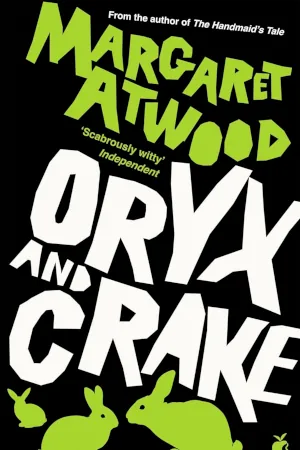
Welcome to the end of the world, brought to you by corporate sponsorship and a reckless pursuit of perfection. In Margaret Atwood's Oryx and Crake, we view the wreckage through the eyes of Snowman - formerly Jimmy - who lives in a tree, haunted by the ghosts of his past and surrounded by the "Crakers," a genetically engineered species of "improved" humans. The landscape is a graveyard of neon ruins and bio-engineered nightmares like pigoons and wolvogs. It is a vibrant, colourful apocalypse that feels sickeningly familiar.
#In most stories, the world ends with a bang or a whimper. Here, it ends with a patent. The society in Oryx and Crake collapsed because it stopped viewing life as a miracle and started viewing it as a series of code sequences to be edited for profit. The breaking point was the "Great Bubble" of the Compounds - gated cities for the elite where ethics were traded for convenience.
When the elite separate themselves from the consequences of their actions, the rot becomes systemic. Crake, the architect of the end, did not hate humanity; he simply found it inefficient. He deleted us like a buggy piece of software to make room for a cleaner version. It is a chilling reminder that the greatest threat to our species isn't our cruelty, but our intellectual arrogance.
Vital reading. It is a map of the ethical minefield we are currently walking through. You will never look at a pharmacy or a laboratory the same way again. Atwood's "speculative fiction" is so grounded in current tech that it feels less like a story and more like a prophecy.
Atwood has crafted a masterpiece of misery that serves as a high-definition mirror to our present. It is not just a book; it is an autopsy of the 21st century performed while the patient is still breathing. We see the greed, the loneliness, and the terrifying speed at which "progress" can become a noose. Keep your eyes on the horizon, but your finger on the page. This world might not be worth saving, but the Crakers are already here, and they are waiting for us to leave.
Silas Vane, 9/10
Oryx and Crake is an exceptionally weird novel that left me baffled, stunned and even disgusted; however, as time went on, it developed into one of the cleverest pieces of fiction I have ever read.
Behind the child pornography, ritualistic killings and animal abuse two young teens relished watching in their spare time on the internet, resided a dormant drive to understanding the excesses of human behaviour in order to dominate it. One of the boys (Crake) is phased by nothing; he is cold, calculating and utterly detached from the passions most people experience. He watches such sick things in order to understand humanity in all its dark and gruesome facets. His best friend, Jimmy, is led along due to his loneliness and curiosity. His personality is overshadowed by that of his more intelligent friend’s. And what they discover together drives Crake onto a very dark and dangerous road.
But why? What’s Crake’s endgame? I couldn’t have guessed until the end. I was sure something big was coming, but I wasn’t expecting something quite as radical as what we got. The set-up for it is massive. I’m currently reading the book for a second time, and I can see all the early warning signs of what’s to come. If I’m being a little bit cryptic here, it’s because I don’t want to land a massive spoiler in your lap. The point is, Atwood has done something exceedingly clever in these pages. And I can’t wait to see where she takes it in the rest of the trilogy. There are so many themes she can address and so many interesting places she can take this.
This is a difficult novel to read in places because it depicts some truly horrible things, but I urge you to look beyond such representations and consider what Atwood was trying to say. It’s worth listening to. And as much as I love The Handmaid’s Tale I would go as far to say that this is a much more accomplished novel. It doesn’t have any feminist qualities, though instead it turns its critical eye towards issue of survival for humanity in a world on the cusp of environmental and economic collapse. It’s on par with 1984 and Brave New World with its subversive qualities and imaginative representation of a future that is not too far from reality.
At times it reminded me of Ishiguro’s novel Never Let Me Go with its depiction of depressed youth in a world the characters cannot fully navigate as they chose to suppress memories and ideas. Oryx is the prime example, but the limiting factor of the novel is its protagonist Jimmy. Jimmy is quite stationary and flat as a character. I hope he progresses in later books as here his experiences are vanilla when compared to what Oryx and Crake have. He felt like a means to tell their story, a mere narrative device, so I’m hoping (given how this novel ends) he starts to take a stronger grasp on the story and infuses it with a sense of ownership.
Time will tell, for now this a great book full of great ideas. And potentially, depending how Atwood uses them in the rest of the trilogy, it could be one of the best dystopian fictions ever written.
Sean Barrs, 9.2/10
As my jolly stroll through numerous dystopian visions continues I find myself thoroughly enjoying the journey, being the warped and twisted individual I am. While researching further titles to add to Fantasy Book Review's dystopia section the name of Canadian author Margaret Atwood surfaced repeatedly, most particularly for The Handmaid's Tale and the synopsis was intriguing:
The Republic of Gilead offers Offred only one function: to breed. If she deviates, she will, like dissenters, be hanged at the wall or sent out to die slowly of radiation sickness. But even a repressive state cannot obliterate desire - neither Offred's nor that of the two men on which her future hangs…
But the research also uncovered another Atwood title, enigmatically named Oryx and Crake, whose synopsis slightly edged it in the intrigue stakes:
Snowman may be the last man on earth, the only survivor of an unnamed apocalypse. Once he was Jimmy, a member of a scientific elite; now he lives in bitter isolation and loneliness, his only pleasure the watching of old films on DVD. His mind moves backwards and forwards through time, from an agonising trawl through memory to relive the events that led up to sudden catastrophe. His only witnesses, eager to lap up his testimony, are "Crakers", laboratory creatures of varying strengths and abilities, who can offer little comfort. Gradually the reasons behind the disaster begin to unfold as Snowman undertakes a perilous journey to the remains of the bubble-dome complex where the sinister Paradice Project collapsed and near-global devastation began.
This sounded like just my cup of tea, so I got hold of a copy and started reading immediately. And it was as great as it promised to be and I was hooked from the very first page until the last.
I loved the book's structure. It begins at the end. A haunted man called Snowman, the last human being, living in a tree and hearing voices. What has happened to the world? What happened to the boy that was Jimmy? Well, that is what the book is all about and the finding out always made for compelling reading. It was a bravely written book in that none of the characters are actually likeable and all are flawed, even by human standards, but very real. And Atwood does not judge, even when covering such difficult and emotive subjects as child prostitution and pornography. The hook of the book, and what kept me reading so enthusiastically, was to find out how the Earth had become what it was and who was responsible. It made for a great and eerily plausible story, one that highlighted human malice, greed and stupidity.
The Observer called Oryx and Crake "a parable, an imaginative text for the antiglobalisation movement" while the Saturday Telegraph called Atwood "one of our finest linguistic engineers. Her carefully calibrated sentences are formulated to hook and paralyse the reader". In Oryx and Crake Margaret Atwood shows us a chilling dystopian world ravaged by natural disasters where the wealthy are segregated from the plebs in gated compounds and science is abused in the pursuit of perfection.
And a special mention must be made of the audiobook version of Oryx and Crake, read magnificently by John Chancer.
Now that I have discovered Margaret Atwood and have realised what a remarkable author she is I will be reading much for of her work in the very near future, with The Handmaid's Tale next on the list.
Margaret Atwood is the author of more than thirty books of fiction, poetry and critical essays. The Handmaid's Tale, Cat's Eye and Alias Grace have all been shortlisted for the Booker Prize, Oryx and Crake for the 2003 Booker prize.
Floresiensis, 9.7/10
Reviews by Sean Barrs and Floresiensis and Silas Vane
1 positive reader review(s) for Oryx and Crake
1 positive reader review(s) in total for the The Maddaddam Trilogy series
Arthur from US
Oryx and Crake is a chilling, prophetic masterpiece that stands as a high-water mark for speculative fiction. Margaret Atwood does not just build a world; she holds up a distorted mirror to our own corporate greed and bioethical experiments. As someone who has lived through decades of post-apocalyptic literature, I can confidently say this is a 10/10 experience that lingers in the mind like a fever dream. The narrative, seen through the eyes of "Snowman" - possibly the last human alive - shifts between a desolate present and a pre-apocalyptic past dominated by ruthless pharmaceutical compounds. What makes this novel so haunting is how plausible the "Waterless Flood" feels. Atwood eschews traditional sci-fi tropes for "speculative fiction," using technologies and social trends that already exist today, which makes the eventual collapse feel inevitable rather than fantastical. Atwood's writing is sharp, cynical, and blackly humorous. She captures the loneliness of the end of the world with heartbreaking precision. The bio-engineered "New Humans" are a fascinating exploration of what humanity looks like when stripped of jealousy, religion, and hierarchy. It is a scathing look at a world where everything, including life itself, has a price tag. "He's forgotten what it's like to be a normal person. He's forgotten what it's like to be any kind of person at all." Through the complex friendship between Jimmy and the enigmatic Crake, Atwood explores the thin line between genius and madness. This is not just a story about the end of the world; it is a profound meditation on what it means to be human in a world that has outgrown its own morality.10/10 (2026-01-21)
Elle from US
Oh my god, where do I even start? If you haven't read Oryx and Crake yet, please drop everything and go find a copy. I've read a lot of dystopian fiction, but Margaret Atwood is on a completely different level. She doesn't just build a world; she predicts one that feels so real it's actually kind of terrifying. I am obsessed with the "Compounds" versus the "Pleeblands." It is such a clever (and scary) look at where our society is heading - total segregation between the tech-elites and everyone else. And the bio-engineering? The Pigoons! The Wolvogs! It's so imaginative but grounded in actual science. Atwood calls this "speculative fiction" rather than sci-fi because she only writes things that humans are already capable of doing, which makes the whole story feel like a "not-so-distant" future. I love that our protagonist, Jimmy, isn't some classic hero. He's just a guy who was caught in the middle of a world he didn't fully understand. His friendship with Crake is so complex and toxic, and his love for Oryx is so tragic. Watching him try to explain our dead world to the Crakers - those sweet, green-eyed genetic masterpieces - is both heartbreaking and hilarious. It makes you realize how much of our culture is just... nonsense when you try to explain it to someone "perfect." This isn't just a "misery fest." It's a wake-up call wrapped in a page-turning mystery. You're constantly trying to piece together how the world actually ended while Snowman struggles to survive in the heat. It's witty, it's dark, and the prose is just beautiful. It's the kind of book that stays in your brain for weeks, making you question every piece of plastic and every pill in your medicine cabinet. It's a haunting, beautiful, and wildly smart ride. Just... maybe don't read it right before you go to sleep if you're prone to weird dreams about glowing rabbits!10/10 (2020-01-07)
9.8/10 from 3 reviews
Discover the best 100 best fantasy books featuring essential classics and the latest modern hits.

Explore the best fantasy book series of all time with our definitive guide to epic sagas.

Discover the best fantasy books from the last twenty years for your next epic adventure.

Explore definitive lists of the best fantasy books organized by popular and niche literary subgenres.

Discover exclusive insights and deep-dive conversations with the world's leading creators of modern fantasy fiction.

Use Google's advanced search to find the very best fantasy reviews, authors, best of lists and interviews.